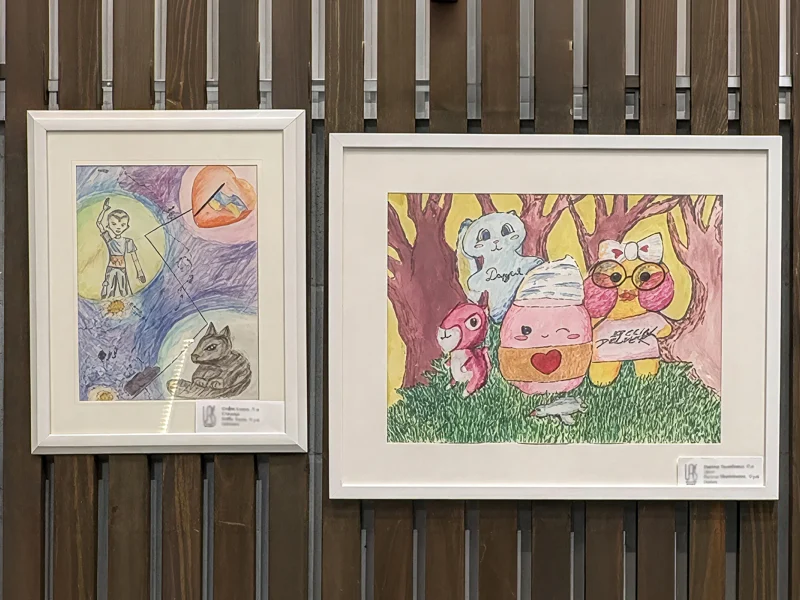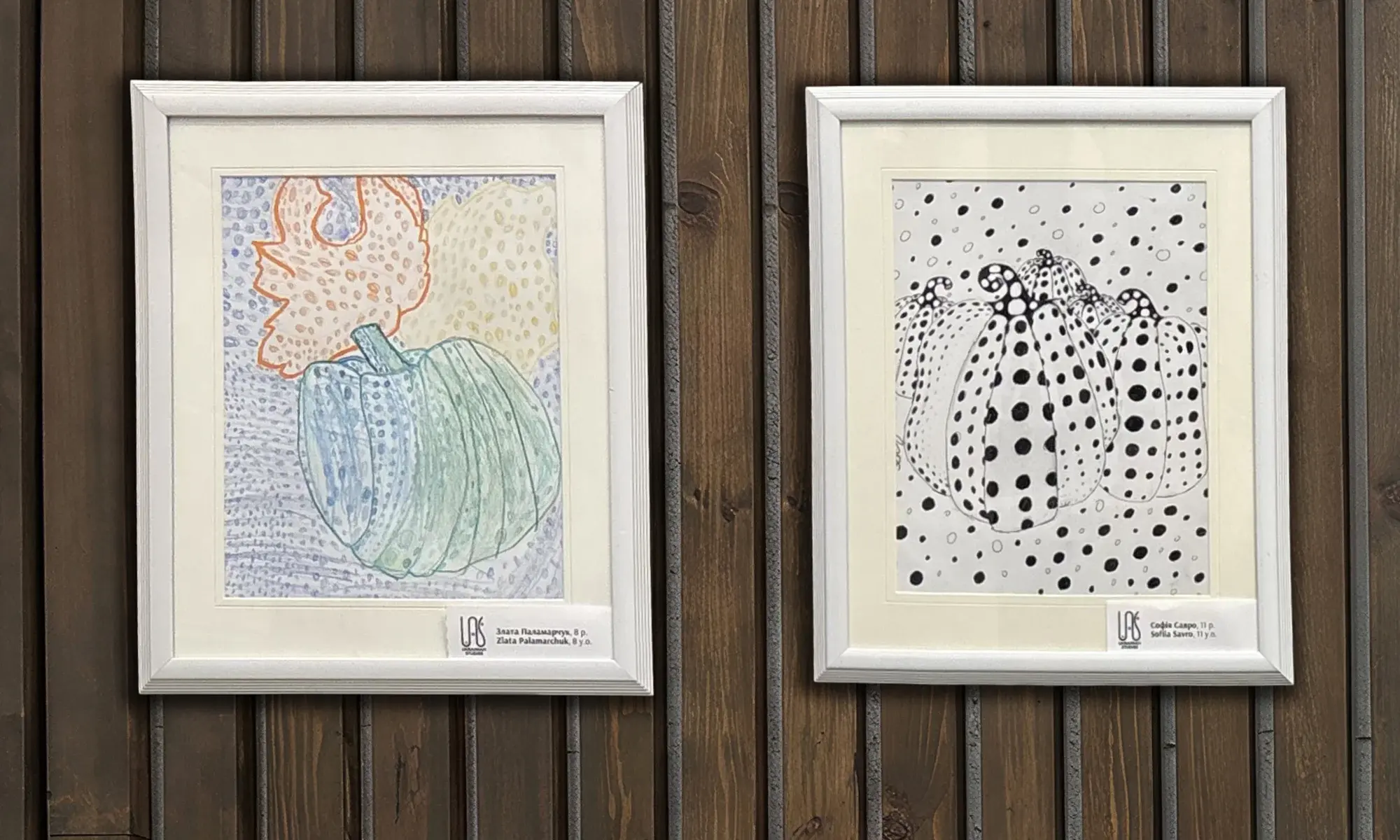
“Yayoi Kusama’s Dots: Pumpkin” brings Kusama’s legacy, the Ukrainian pumpkin and Halloween into dialogue in works by young artists of Ukrainian Studies.
Art preserves the experience of an era and shapes the ways in which it is understood and passed on to later generations. In today’s world, where cultural traditions are in constant interaction, initiatives that combine art education with a critical engagement with the world’s artistic heritage take on particular importance.
It is on these foundations that the creative project “Ukrainian Studies” develops its work, treating artistic practice as a tool for cultural understanding, intellectual independence and the formation of aesthetic awareness. Its educational concept rests on the conviction that openness to other cultures requires, first of all, an awareness of the value of one’s own heritage, and that genuine intercultural dialogue demands the ability to distinguish between creative influence, imitation and appropriation.
For Ukrainian society, these questions are especially pressing. Centuries of imperial policy by muscovy (russia), aimed at assimilating and marginalizing Ukrainian culture and appropriating its achievements, show convincingly that a lack of historical knowledge and critical reflection creates the conditions for the distortion of cultural memory. In this context, art education goes beyond mastering techniques and artistic means and becomes an important part of building cultural agency.
In contrast to the appropriation of the world’s cultural achievements by muscovites, Ukrainian Studies has carried out a project that brings together, on equal terms, the Ukrainian traditions of celebrating the harvest in song (for example, “Khodyt Harbuz po horodu” — “The Pumpkin Walks in the Garden” — which dates back to the nineteenth century), the Halloween celebration popular in many countries, and the individual artistic manner of the Japanese artist Yayoi Kusama (1929–2026). In keeping with the project’s concept, the greatest emphasis was placed on a tribute to the memory of this outstanding artist, one of the most influential figures of postwar and contemporary world art, which is reflected in the title of the exhibition: “Yayoi Kusama’s Dots: Pumpkin.”
Kusama, who passed away on 14 August 2026 at the age of 97, left a unique artistic legacy spanning painting, sculpture, installation, performance and literature. Her work, formed at the crossroads of avant-garde experimentation, personal psychological experience and a philosophical contemplation of infinity, significantly expanded our understanding of the interplay between the artwork, space and viewer.
About the exhibition
- Title: “Yayoi Kusama’s Dots: Pumpkin”
- Organizer: Ukrainian Studies
- Participants: young participants of the Ukrainian Studies art program
- Dedicated to: the memory of Yayoi Kusama (1929–2026)
- Idea: the Ukrainian pumpkin tradition, Halloween and Kusama’s artistic language in dialogue
The Aesthetics of Infinity: Yayoi Kusama’s Visual Language
Kusama’s artistic achievement lies in her ability to turn individual experience into a universal system of images in which the simplest elements acquire complex conceptual meaning.
Infinity Nets, polka dots, Infinity Mirror Rooms and sculptural pumpkins formed a recognizable aesthetic built on rhythm, multiplicity and the optical overcoming of spatial boundaries.
The dot — an elementary geometric form — ceases to be a decorative motif in Kusama’s art. Through endless repetition, it becomes a means of rethinking the relationship between part and whole, the individual and the universal, the material and the imagined.
The origins of this imagery lie in the artist’s childhood experiences, in particular the hallucinatory visions she described, in which ornamental patterns seemed to swallow the objects around her and her own body. This experience later found artistic form in the concept of self-obliteration — the symbolic dissolution of the individual “self” into the boundlessness of the universe.
The paradox of Kusama’s art is that the outward decorativeness of her works conceals complex existential questions. Rhythmic repetition, bright colours and visual play become ways of exploring the fragility of human identity, psychological vulnerability and the desire to overcome the limits of one’s own existence.
The pumpkin holds a special place in Kusama’s artistic system — an image that combines autobiographical memory, organic form and the symbolism of resilience.
Its origin goes back to the artist’s childhood in the Japanese city of Matsumoto, where her family grew plants and seeds. Recalling her early encounters with pumpkins, Kusama endowed them with almost animate features, seeing in their natural form a kind of individuality. In her work, this ordinary agricultural fruit gradually became a self-sufficient artistic symbol. Its sculptural fullness, rounded contours and the rhythmic ornament of dots lend it both monumentality and vivid vital energy. Unlike the mirrored installations, which create the illusion of dematerialized space, the pumpkin retains a sense of physical presence, bodily weight and an organic bond with the earth.
The duality between the concreteness of a natural form and the abstract infinity of ornament makes the image open to interpretation in different cultural environments.
“Yayoi Kusama’s Dots: Pumpkin”: A Meeting of Cultural Traditions
The exhibition project by Ukrainian Studies invites viewers to reflect on Kusama’s legacy through an unexpected yet conceptually grounded juxtaposition of her artistic language with the imagery of the North American tradition of Halloween.
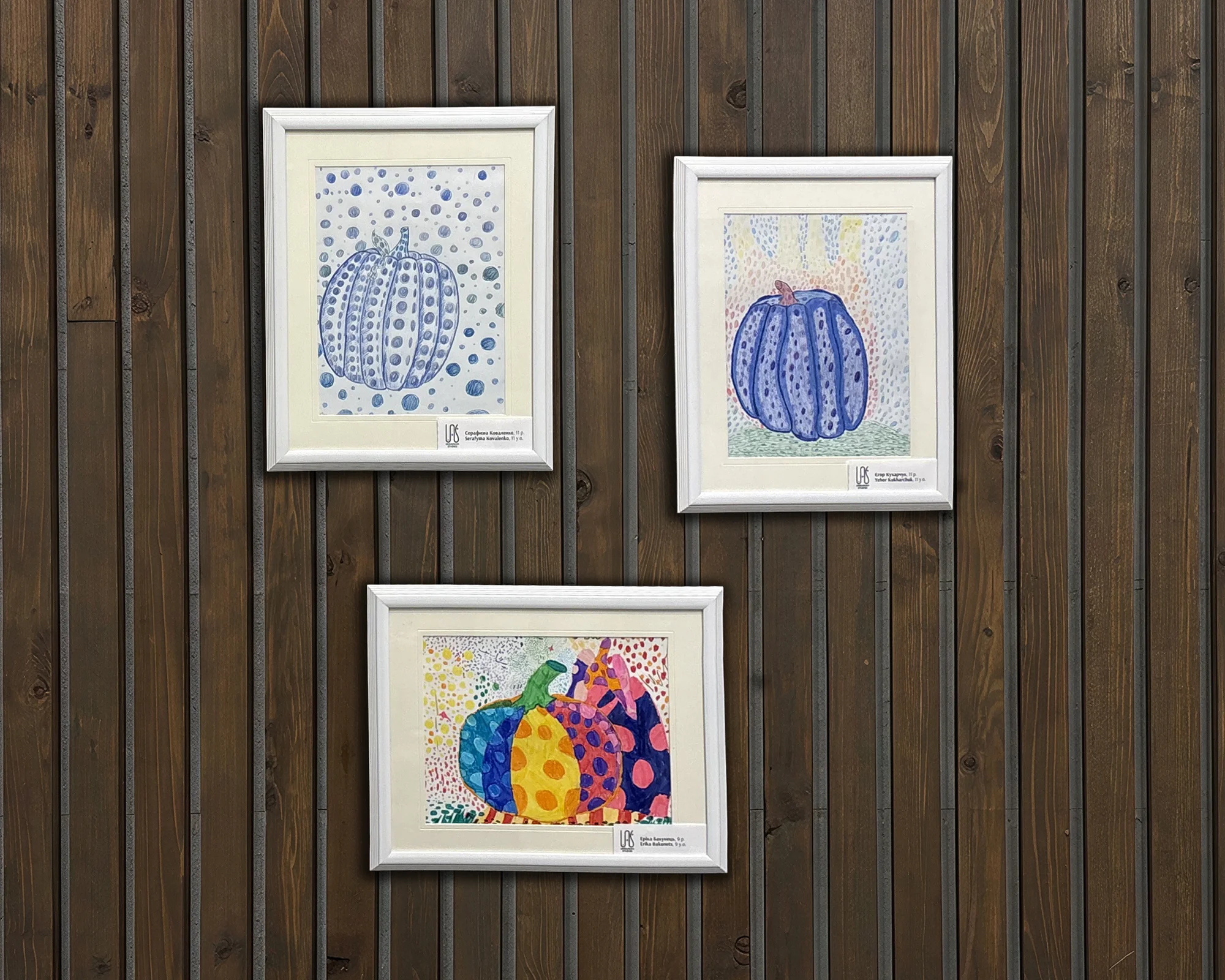
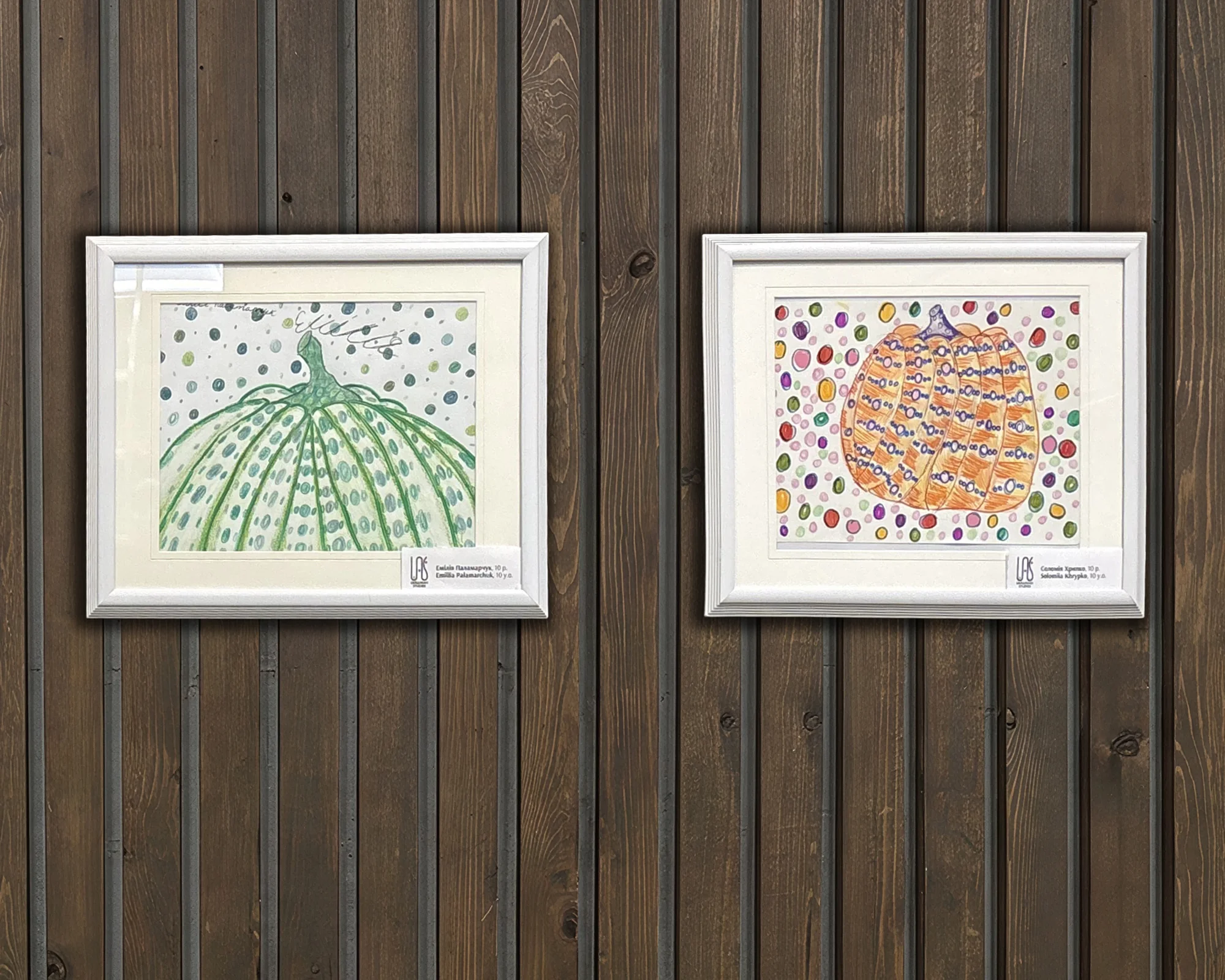
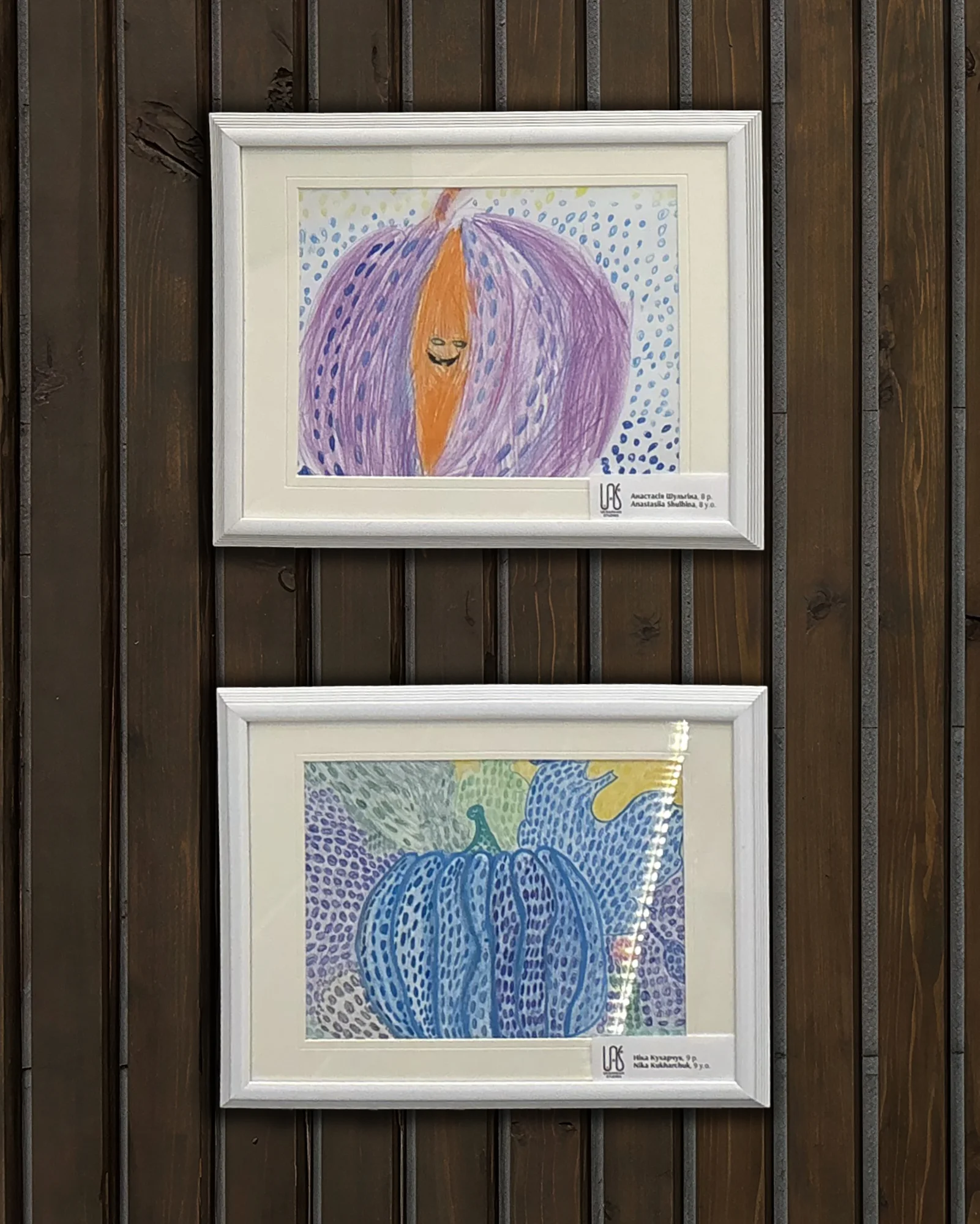
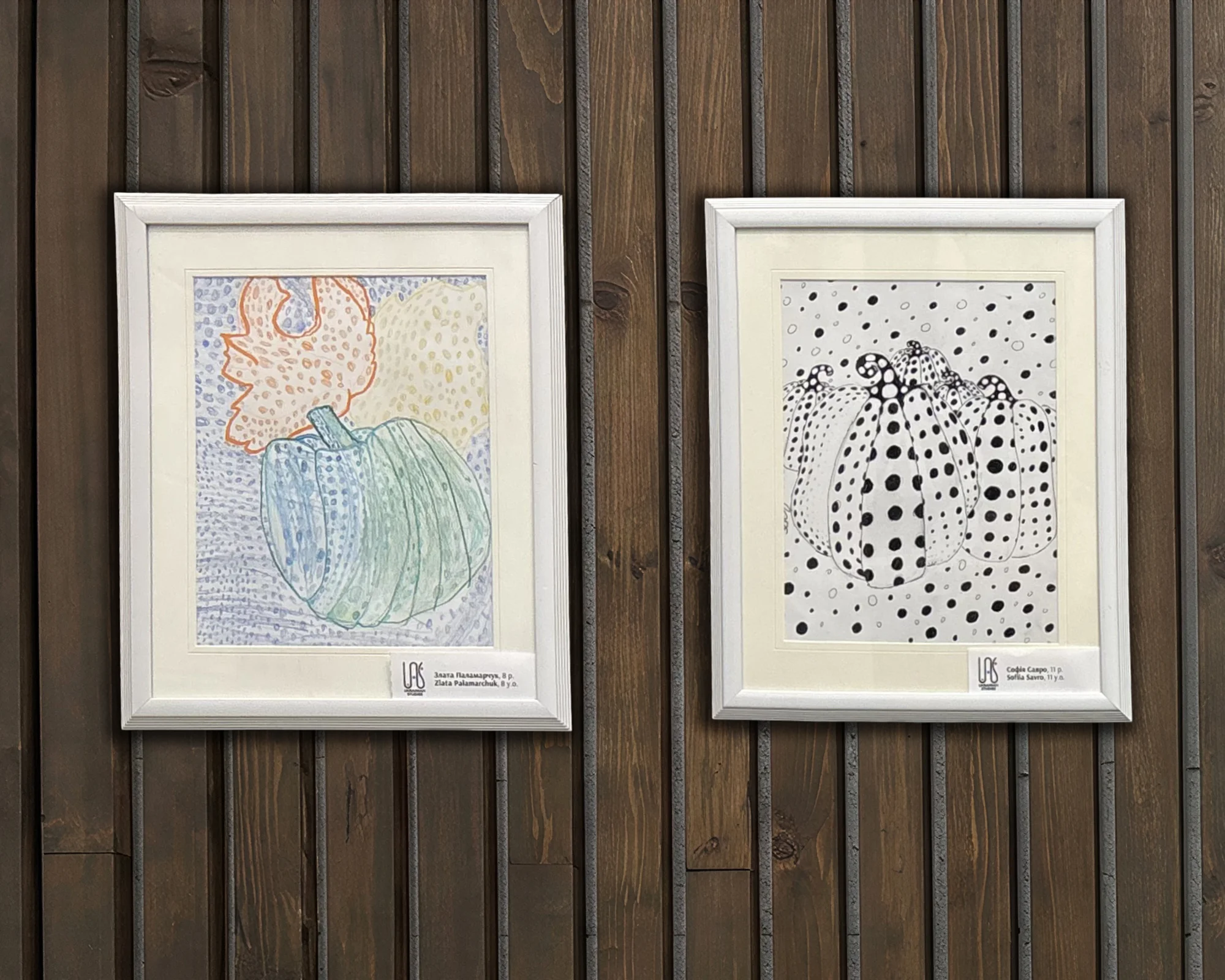
The exhibition consists of works by young participants of the art program, who turned to the image of the pumpkin as a shared visual motif of distinct cultural contexts.
In the Ukrainian tradition, the pumpkin is linked not only to the ritual calendar of the harvest celebration but also to the season of autumn betrothals. Incidentally, a girl who refused to marry a suitor would serve him a pumpkin during the matchmaking — for, among its other symbolic qualities, this vegetable has a mild calming effect when eaten.
In the Halloween tradition, the pumpkin is associated with seasonal rituals, masquerade culture and the symbolic transformation of an everyday object into an emblem of the holiday. In Kusama’s work, by contrast, it appears above all as a personal image tied to childhood memories, natural harmony and the life-affirming power of art.
Despite their outward similarity, these images belong to different systems of meaning. It is precisely their juxtaposition that forms the conceptual core of the exhibition.
Drawing on Kusama’s characteristic rhythmic structures and ornamental principles, the young authors rethink a familiar emblem of the autumn holiday, giving it a new visual voice. The Japanese artist’s visual language becomes a kind of mediator between cultural traditions, and the creative process becomes a way of exploring the possibilities of their interaction.
It is essential to note that this approach does not involve literally reproducing the author’s style. Its aim is to become familiar with the logic of Kusama’s artistic thinking, to grasp the conceptual nature of her images and to apply the experience gained in one’s own creative work. Such an understanding of artistic practice moves the learning task into the realm of cultural interpretation, where what matters is not formal resemblance to the original but the ability to build an independent artistic statement.
The Culture of Memory as Creative Practice
A distinctive feature of the exhibition is its treatment of memory not as the passive preservation of the past but as a process of bringing it back to life through art.
After her death, turning to Kusama’s legacy takes on the meaning of a creative tribute, in which the historical figure remains present through new interpretations of her artistic ideas. In this sense, the exhibition goes beyond a memorial dedication, raising questions of continuity, cultural translation and responsibility to an artistic tradition.
At the same time, the project highlights the fine line between creative borrowing and superficial stylization. In a globalized cultural space, where artistic images are quickly turned into mass-produced visual signs, an understanding of their origin and original meaning becomes especially important.
Kusama’s dots long ago left museum exhibitions behind and became part of popular visual culture. Yet behind their instant recognizability lies the artist’s complex personal and creative experience. Returning to this context makes it possible to see, behind the striking form, the intellectual and emotional depth of artistic expression.
That is why the children’s participation in the project is especially meaningful. Engagement with the world’s artistic heritage takes place not through the mechanical absorption of stylistic features but through an understanding of the relationship between image, authorial intention and cultural environment.
For Ukrainian children growing up in the multicultural environment of Canada, this experience offers a chance to explore other artistic traditions while becoming aware of their own cultural identity. Art becomes a space in which differences are not flattened but gain meaning as a source of creative inquiry.
Art That Endures
The exhibition “Yayoi Kusama’s Dots: Pumpkin” shows how the legacy of an outstanding artist can receive a new reading in an educational and intercultural setting without losing its connection to its historical and conceptual origins.
Ukrainian Studies’ engagement with Kusama’s work is at once a gesture of remembrance and evidence of a consistent cultural stance: knowledge of world art must be grounded in respect for its authenticity, intellectual openness and an awareness of one’s own cultural agency.
In this context, children’s creativity emerges not as a peripheral echo of great artistic movements but as one of the ways in which they continue to exist. After all, the true significance of an artistic legacy is revealed not only in its historical recognition but also in its capacity to inspire later generations to think and create independently.
Memory in art is both the preservation of the past and the possibility of giving it new meanings. It is in this continuity of interpretations that artistic heritage overcomes the boundaries of time, retaining its ability to speak to the future.